National Rat Summit summary
I recently had the privilege to attend the 2026 National Rat Summit in Boston. I was pleased to see general agreement that rodenticides are at best an imperfect tool for emergencies, and at worst an environmental crisis. I was also happy to see that IPM is still the right way to approach pest issues, even huge city-wide problems. Contain trash, repair infrastructure, and engage and educate the public—that’s the tl/dr!
I. Rats are widespread in cities, and are disease vectors
A. Leptospirosis, easily spread through rat urine and other routes, is the most prominent concern, and is the most widespread zoonotic disease in the world. Approximately 20% of the Boston rat population is infected
B. Rats from a NYC study were shown to carry up to 6 species of ectoparasites, including important flea and louse vectors, as well as mites known to bite humans. 90% of rats in the study had at least one ectoparasite on board. Flea-borne Typhus (“murine Typhus”) is rebounding after being almost entirely eliminated by use of DDT, and has been found in Texas, California, and Georgia. Most states do not require Typhus to be reported.
C. Rats from various other studies were found to carry gastrointestinal worms, zoonotic worms, disease causing protists Toxoplasma gondii and Leishmania spp., disease causing bacteria Bartonella sp. and Campylobacgter jejuni, and 11 other potentially pathogenic bacteria, as well as viruses Hepatitis E, Seoul virus, and Hanta virus.
D. High levels of rat-spread disease are correlated with high levels of socioeconomic disparity. Homeless encampments are particularly impacted by diseases such as Rickettsia spread by rats. Risks posed by rats are elevated in areas with old infrastructure.
E. The public health problem is not the rats but the interface between an infected rat, a contaminated environment, and a person.
II. Rodenticides are in widespread use, but experts consider them to be a high risk/low reward tool.
A. SGAR (anticoagulant rodenticides) are proven to cause secondary toxicity, including lethal toxicity. SGARs are found in nearly all the raptors that are necropsied at Tufts Wildlife Clinic. SGARs have been detected in animals not directly related to the rodent/rodent predator relationship, including frogs and leaf-eating marsupials in Australia. The issue is a global conservation concern.
B. Rodenticide resistance is on the rise, especially in Europe where rat dropping analysis shows up to 40% of urban rats and over 90% of rural rat populations are resistant to anticoagulants.
C. SGARs are strictly regulated in many places, but internet sales provide a loophole, allowing many millions of dollars' worth of SGAR product to be purchased without regulation.
D. There is now evidence that one popular SGAR alternative, Bromethalin, causes secondary toxicity. This is especially worrying because diagnosis of Bromethalin toxicosis is difficult, antemortem signs are nonspecific and variable, and gross postmortem and histological signs may be absent
E. There is strong public support for the concept of rat fertility control as a rat abatement strategy, but there are no proven products on the market. A study in NYC showed no significant difference in rat populations between sites managed with one of three contraceptive baits, and the control site, despite high palatability of 2 of the 3 bait types. Anecdotally, officials in France saw some improvement with the contraceptive products available to them. Expert consensus is that these products are not yet effective enough to be useful.
F. Well-fed rats may not enter bait stations.
III. Management of the primary urban rat food source, human generated refuse, is likely to be the key to reducing rat populations. Likewise, harborage management (habitat modification) is important
A. New York City began to see steep declines in rat reports from the public following the rollout of a series of new pest-resistant trash containers.
B. There is a large financial investment required to overhaul a municipal trash system, but the benefits of disease reduction and citizen wellbeing are arguably worth it. Each city has its own challenges, such as curb space, truck access, uneven or hilly terrain, and resident preferences.
C. A population of rats that suddenly have their food supply removed are easier to trap with traditional methods, and fecundity diminishes.
D. Urban community gardeners are at higher risk of Lepto because of their close contact with the soil and objects in and around the soil that rats may have contaminated. The strongest predictor of whether a community garden will have rats is the proximity of garbage cans. Municipal teams help educate these folks and encourage them to reduce clutter and trash, discourage feeding of wild and feral animals, and eliminate dog waste. Open compost areas can encourage rats, while properly contained compost will not.
E. One urban university campus rat management system relies on working with neighbors and stakeholders to manage trash better and to reduce harborages provided by the landscape. Keeping vegetation away from buildings—including ivy climbing the buildings is one part. Removing or trimming low shrubs that provide cover for rats is another. Old university buildings may be vulnerable at the ground level—broken and decaying masonry should be repaired where possible and creating a barrier of sharp 1.5 inch stones, four inches deep, has become standard. Where that is not possible, this team was able to install sheets of Xcluder fabric and put a thin layer of soil above that. Grass can return, but rats cannot dig through the Xcluder fabric to burrow in the soil
F. One study found that vegetation very close to a building increases rat populations while plots of green space 1500 meters from urban infrastructure reduce rat populations.
G. The availability of “transient organic waste” creates sites where animals of different species may transmit pathogens to one another, which is linked with pathogen abundance and diversity.
IV. Some new technologies are helping with rat control efforts
A. New rat resistant trash containers and snap trap boxes are being used by a dedicated Boston Housing Authority Rat Team.
B. Carbon monoxide sprayers have been widely adopted by diverse stakeholders in the rat control field. More work needs to be done to ascertain how safe these machines are to operate—some agencies use hearing protection, some use carbon monoxide detectors in areas away from the treatment zone, some follow label instructions religiously, some are more improvisational.
C.. Infrared detectors and thermal imaging devices can be useful for understanding the routes and behaviors of a given rat population. One group is also using ultrasonic microphones to detect rat activity levels, and discovered that rats vocalize all night long, and rat voices are distinct from one another, when the waveforms are compared. They expect to make discoveries about previously unknown rat behavior and describe their work as “approaching pest control through neuroscience.”
D. A European company worked with Boston officials to use modified captive piston traps to kill rats in the sewers of the North End. They found some designs were rendered ineffective by the vibrations of the traffic above. They also saw a massive increase of rat kills in November, which Rodentologist Bobby Corrigan suggested was likely due to “vertical migration” of rats into the sewers as the weather gets cold. By entering manholes to service these traps, this team was able to see that the old brick construction of these spaces is exploited by rats burrowing into gaps. This was in a part of the city where the storm runoff and sewer lines have not yet been separated. Separating these two plumbing systems has also been shown to reduce rats, since storm drains that connect to sewers allow rats to access grease build-up in sewers as a food source.
V. The Proactive approach is the most effective.
A. Any area where rats may be an issue must be surveyed and understood. Rats live in complex three-dimensional spaces, utilizing sewers and subways, traveling along routes that are hidden from normal human observation. Anticipating their movements and understanding the subterranean landscape can be key to addressing problems when they arise. Exclusion efforts that prevent the movement of rats from harborages into areas where they can cause the most harm are more efficient than a strategy of reacting when problems arise.
B. Providing appropriate containers for trash, compost, and dog waste is a proactive way to prevent providing a food source to rats and other pests. Municipalities that add food waste composting to their sanitation efforts remove these materials from the main waste stream, reducing the attractiveness of trash. Small, well-built compost containers have been found to be more rat-resistant than many other kinds of containers. Some cities charge different rates for different container sizes to incentivize compost container use. Some cities have mandatory diversion of food waste from the waste stream.
VI. Monitoring rat situations before and after interventions is extremely important
A. AI assisted monitoring, connected traps, sewer surveillance, and predictive GIS are improving the detection of rats.
B. Correlation of rat complaints with other nuisance reports and information on infrastructure can help direct priorities in preventive measures.
C. Rat surveillance (detecting and sampling rats and their droppings) can help identify where pathogen exposure might be concentrated, which environmental conditions favor transmission, and where rat-control efforts are likely to have the greatest public health relevance.
D. Many municipalities do not have budgets for surveillance, hindering prevention efforts
VII: Successful rat prevention and control efforts require collaboration with many agencies and stakeholders, as well as effective community outreach and education.
A. Rats are not aware of property lines, municipal jurisdictions, or state or national boundaries. Failure to coordinate across the entire rat habitat area will result in constant reinfestation. On the city level, there must be coordination between sanitation services, water and sewer authorities, health departments, and housing authorities. There should be someone tasked to coordinate efforts across these agencies and a consistent IPM plan to follow. Ideally, these agencies would coordinate with their counterparts in adjacent municipalities.
B. The public must be educated and motivated to do their part to control the problem. Municipal rat control projects work best when the public has an interest in reducing rat populations. Municipalities should be clear about what actions are being taken, and what the public can do to help. The public needs to be educated about the health risks of rats, the simple and common-sense prevention strategies, and what actions the municipality is taking to combat the issue. Many cities use a 311 reporting system with GIS location maps that are critical for understanding rat problems.
C. Some agencies have mainly advisory roles. They can analyze citizen rat reports, perform inspections, manage expectations, and make recommendations to property owners. In some cases, these agencies can issue enforcement actions, but the goal is voluntary compliance. One agency found that by emphasizing these steps instead of merely placing rodenticides, they eliminated the use of hundreds of pounds of rodenticides per year. This same agency found that rat reports fluctuated with temperature, availability of rat food sources, and the level of public awareness of the rat issue.
D. Targeted outreach to high-risk groups such as sanitation workers, superintendents, urban gardeners, and people who live or work with homeless encampments can help prevent disease. Dog owners should be made aware of the risks of Leptospirosis. NYC health department officials provided information to sanitation workers in the form of posters as well as in-person appearances at AM roll calls at sanitation department garages.
E. Employees of food facilities should be very familiar with the health code. Health inspectors should discuss IPM with the facilities they inspect, and explain what measures will help protect human health and prevent code violations.
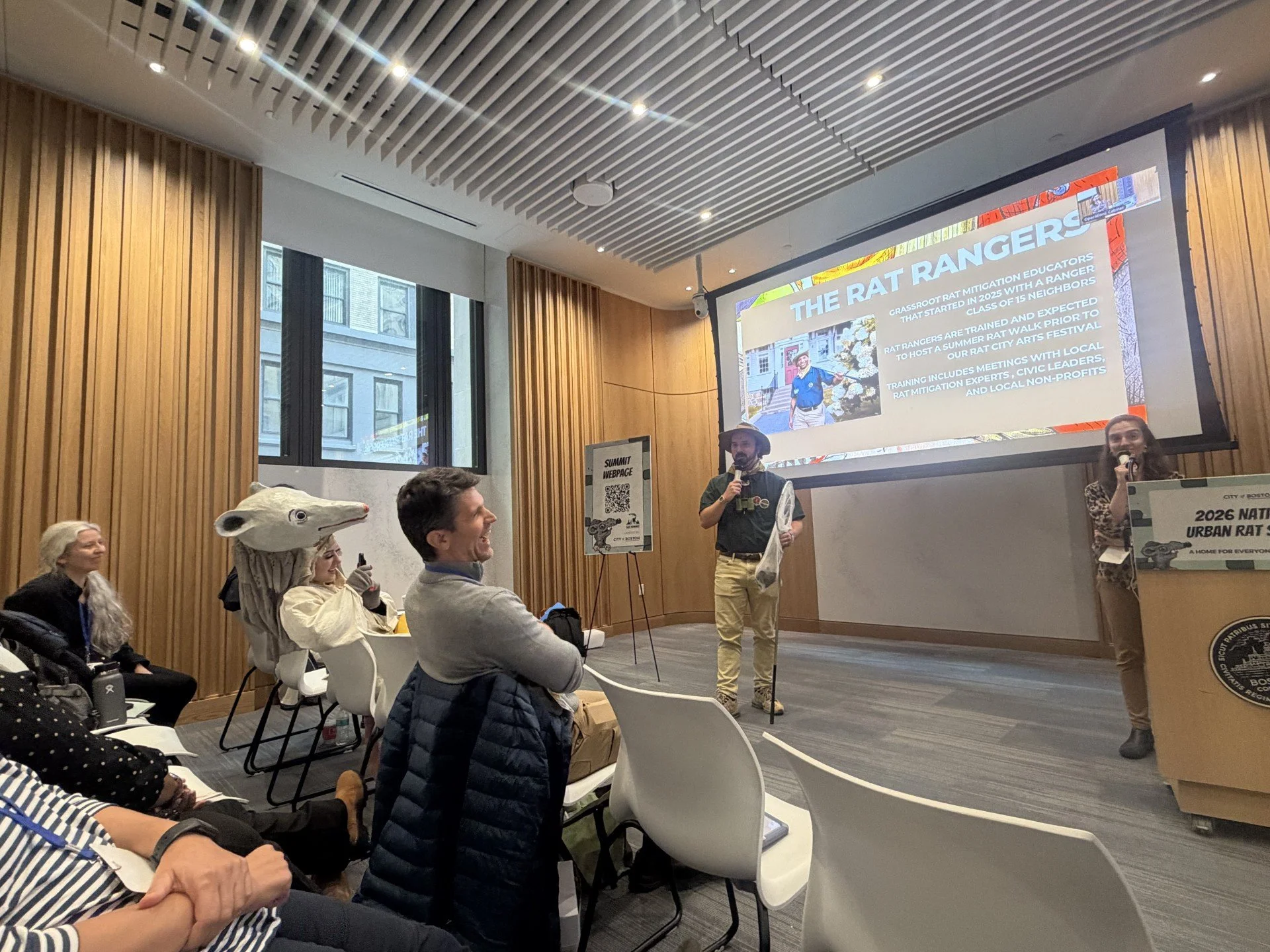
F. Public engagement can take place in the form of fun events. Community organizers in Washington DC and Boston independently came up with the idea of “Rat Rangers,” providing guided walks in their cities to highlight rat problems and offer ideas on how to make neighborhoods less hospitable to rats.
I want to acknowledge the many speakers whose presentations I paraphrased in this summary:
Dr. Bobby Corrigan, America’s premier rodentologist
Dr. Romain Lasseur - Invasive species and pest management expert
Dave de Jonge and Jan Buijs - Amsterdam Department of Public Health
Dr. Jonathan Richardson - University of Richmond
Dr. Claudia Riegal - City of New Orleans Mosquito, Termite and Rodent Control Board
Dr. William L. Nicholson - Centers for Disease Control and Prevention
Marc Paladini, Caroline Bragdon, Martha Vernazza, and Dr. Mindy Chang - NYC Department of Public Health and Mental Hygiene
Dr. Adena Why - Alameda County Vector Control Services District
Dr. Kayty Himmlestein, Boston Public Health Commission
Marykate Kenney, Ally Littlefield, and Dr. Richard Pollack - Harvard University Environmental Public Health Office
Taylor Rubin - Queens College at the City University of New York
Dr. Matt Frye - Cornell Integrated Pest Management
Leslie Frattaroli and Lizzie Rush - National Parks Service National Mall and Memoral Parks
Dr. Changlu Wang - Rutgers University Extension Service
Dr. Maureen H. Murray - Urban Wildlife Institute, Lincoln Park Zoo
Maureen Murray, DVM - Tufts Wildlife Clinic
John Ulrich - City of Boston Environmental Services
Dr. Ralph Peterson - Basis Research Institute
Jeffrey Weisberg - A1 Exterminators
Julie Skovgaard Bahrt - Ratél ApS
Kim Camera - Urban Canine Pest and Wildlife Solutions
Dr. Niamh M Quinn - University of California Division of Agriculture and Natural Resources
Dr. Kaylee Byers and Dr. Chelsea Himsworth - University of British Columbia School of Population and Public Health
Max Broad & Holly Gerberich - DC Responsible Rat Management
Ricky Meinke and Grace F. Evans - Rat City Arts Festival